
There are Minneapolis city elections coming up in November. We’ll be asked to vote for the members of the city council, park board commissioners, Board of Estimation and Taxation (BET) commissioners, and the main event: the mayor.
I’ll be up front for anyone who doesn’t follow me elsewhere: I’m not a big fan of the current Minneapolis Mayor, Jacob Frey, for many reasons. So many, in fact, that I’ve been working on a series of pieces with numerous examples from Mayor Frey’s nearly 8 years in office that I believe make a pretty good case for why he should not continue to serve in that role. For a preview, you can look through this presentation on Frey’s record I put together for a recent Southwest Alliance for Equity (SWAE) event.
But, before I get into my thoughts on the current Mayor’s performance, I want to establish what the generic Minneapolis mayor is supposed to do.
Why should you know this? Because a lot of people don’t want you to.
Both in the 2021 campaign cycle and the current one, PACs, some candidates, and other influential people (usually on the moderate-to-conservative side of the Minneapolis political spectrum) have been sowing misinformation about the mayor’s powers and responsibilities. I can’t see into these people’s hearts, but the goal usually seems to be to make residents think Mayor Frey is responsible for anything good that happens in this city and the current progressive majority on the city council is responsible for anything bad.
Here’s an example from the PAC All of Mpls, which supports Mayor Frey.
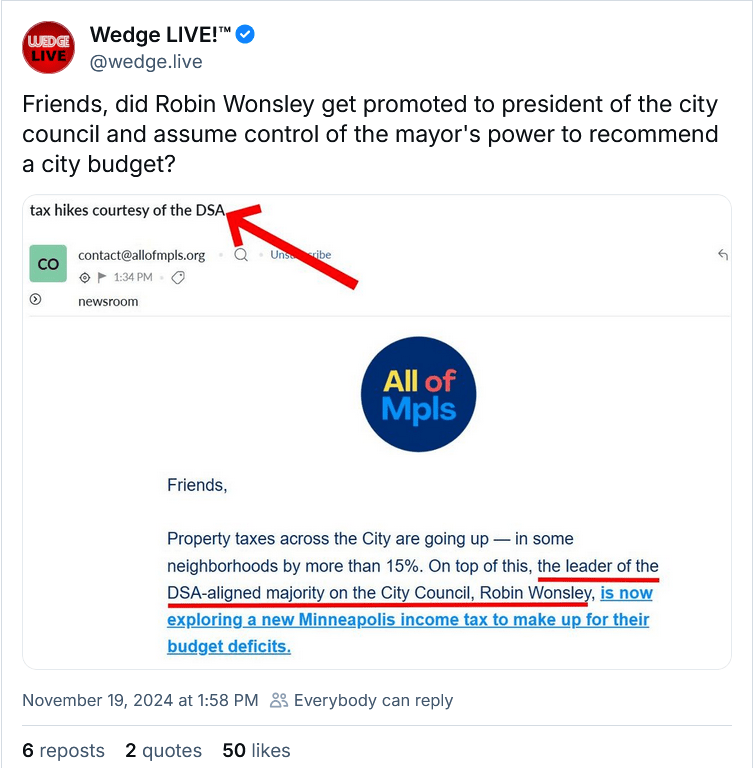
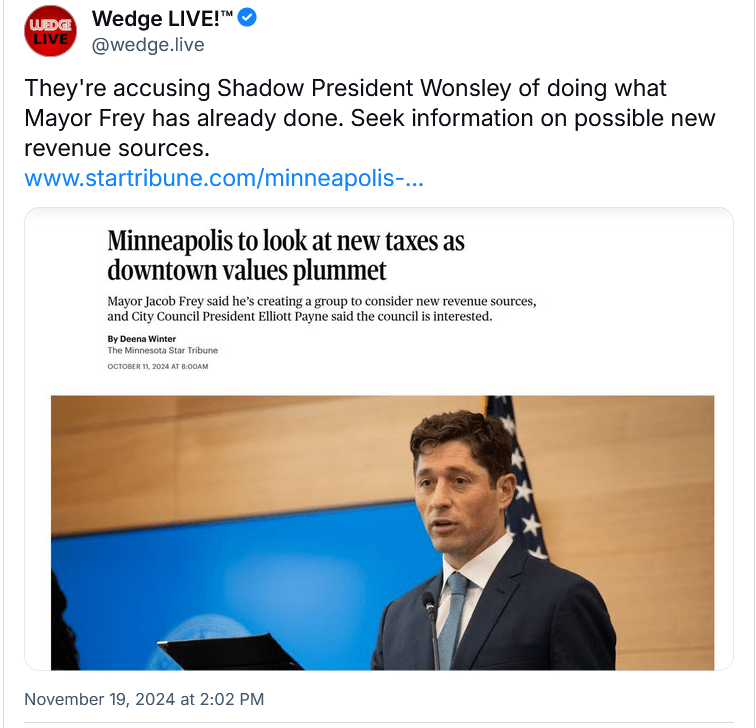
All of Mpls is trying to suggest to readers that any tax increases they experience are the responsibility of the city council, and ward 2 Council Member Robin Wonsley specifically (who, btw, does not actually have a leadership role on the council).
In reality, maximum property tax levies are determined by the BET. Then, the mayor proposes a budget that includes the property tax increase needed to fund that budget (within the limits determined by the BET). Finally, the city council proposes and votes on amendments to that budget which, again, cannot exceed the maximum property tax rate set by the BET. In fact, the current City Council ended up reducing the property tax increase proposed by Mayor Frey in the latest budget cycle.
Of course, All of Mpls is banking on their readers not knowing any of that. And, unfortunately, the only way to counter that misinformation seems to be more people like you and me knowing some of these nitty-gritty details of city government and speaking up when we hear something wrong. So, bear with me. I’ll try to make this as painless as possible.
The Weak Mayor Era
If you lived in Minneapolis during the 2021 election, there was a question on your ballot about changing the city charter (basically, the city’s constitution) to enact a new government structure. Back in 2021, this was known as “Question 1” or the “Strong Mayor Amendment.” That amendment passed, so we now have a different government structure than we did at that time. And, crucially, this changed the powers and responsibilities of both the mayor and the city council. So, since Jacob Frey was first elected in 2017, he has served under both structures.
Why does this matter in this election? Well, when we’re looking at Mayor Frey’s record from his inauguration in January 2018 through the switch to Strong Mayor in late 2021, we need to hold him accountable to the power and responsibilities he had at that time. I’ll call that period the “Weak Mayor Era.”
Possibly the most important thing to know about this era is something that did not change with the Strong Mayor amendment. Let’s hear it directly from then-Council Member Jacob Frey.
I think it goes without saying, but we’ve had a massive uptick in violent crime, specifically shootings. And some of the worst police-community relations in a long time. And that’s the Mayor’s job. The police report directly to the Chief, the Chief reports directly to the Mayor, and, ya know, that’s how it works.
If you want to hear it in his voice, this quote is from a 2017 campaign video, which you can watch here.
Frey is right! One truth that has remained constant throughout Mayor Frey’s tenure, across both the Weak and Strong Mayor Eras, is the ultimate accountability of the Minneapolis Police Department (MPD). Another layer of management was added in 2022, as part of the Strong Mayor restructure. But, ultimately, the Mayor of Minneapolis was and is the ultimate boss of the MPD.
This isn’t to say that the Mayor can do whatever they want with the MPD. There are several layers of city and state laws, and union contracts, that establish boundaries and lines that they have to work within. I’ll get into that a bit more in future articles. But, the bottom line here is, when you go up the line of accountability for the MPD, the Mayor is at the top.
The other important thing to know about our old system was the so-called “14 bosses” problem. Before the Strong Mayor restructure, the org chart for city departments looked like this.
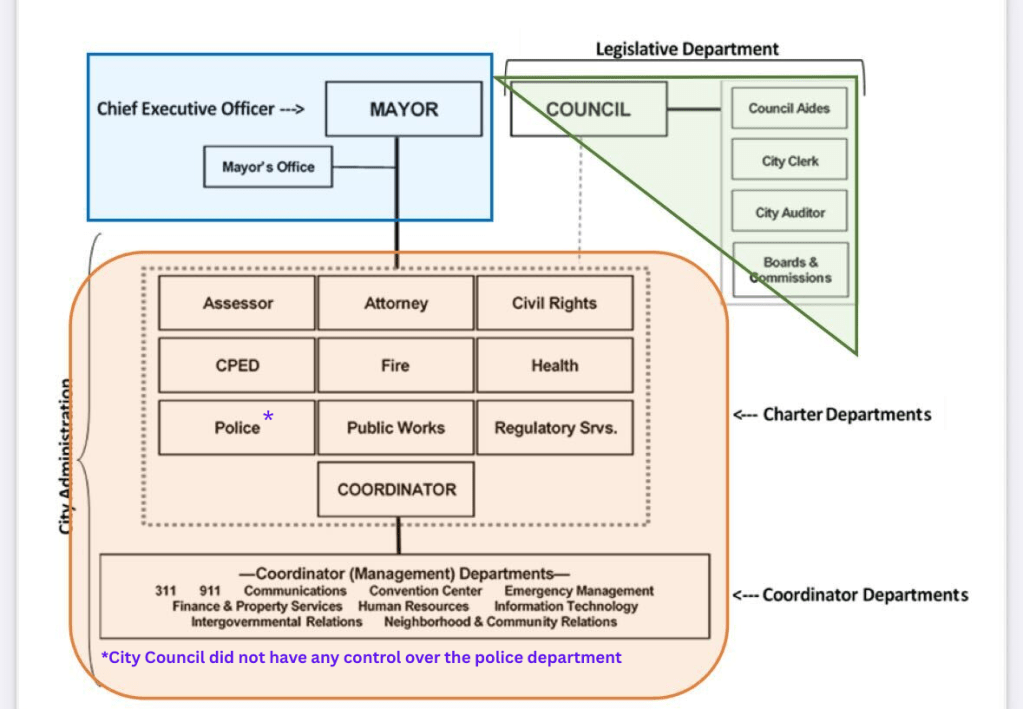
You’ll see here that the Mayor is at the top of the chain of command for the “city administration” (all of the departments that handle the day-to-day operations of city services). However, there’s a dotted line and box that also connects many of these departments to the council. That’s because the city council did have some power over these departments in this structure. Hence, some say the heads of these departments had “14 bosses”一the mayor, and the 13 council members.
Caveat: You’ll also see that I added a note in purple that this is true for all departments except the police department. There’s a carve-out in the city charter that says the mayor has “complete power over the establishment, maintenance and command of the police department.” The 2021 public safety charter amendment (“Question 2”) tried to change this and give the city council the same authority over the police as any other city department. But, alas, it failed.
Back to the 14 bosses. In this previous structure, the city council had to vote to approve most of the high-level managers of city departments and they also had to vote to confirm whether one of them would be fired. They also had some freedom to speak and collaborate directly with specific city staff. Critics of this system of government say that it’s stressful for those individuals who have to please both the mayor and the majority of the city council in order to feel secure in their jobs. It’s also inefficient, because all 14 of the “bosses” theoretically could make requests of a department head or their staff (through official channels, or unofficial ones), which the department heads would then have to manage. Solving this problem was the most common argument made in favor of changing to the Strong Mayor system.
The Strong Mayor Era (Current)
I voted against the Strong Mayor Amendment. I wrote a separate piece about that, and the realities of the resulting restructure. But, to summarize, I think the Strong Mayor system is less democratic. Of course, if you look at it from a business-employee perspective, having one boss is more efficient and less stressful than having 14 people asking you favors and evaluating your performance. But, democratic governments intentionally elect a body of many representatives to do some of the governing because they can be more, well, representative of the needs of the people in their ward or district. One person, no matter how well-meaning, just can’t do that. And there are fewer safeguards in place in this new structure for the case of a mayor who is not well-meaning (which we’re currently seeing play out on a massive scale in the federal government).
But, it’s the system we have now. So, I will say one thing in its favor: it has made the lines of accountability for city staff and services much clearer. Under our current system, Mayor Frey is ultimately in charge of all city department heads and is accountable for the results they produce. Full stop.
Here’s the current city org chart, under the Strong Mayor system.
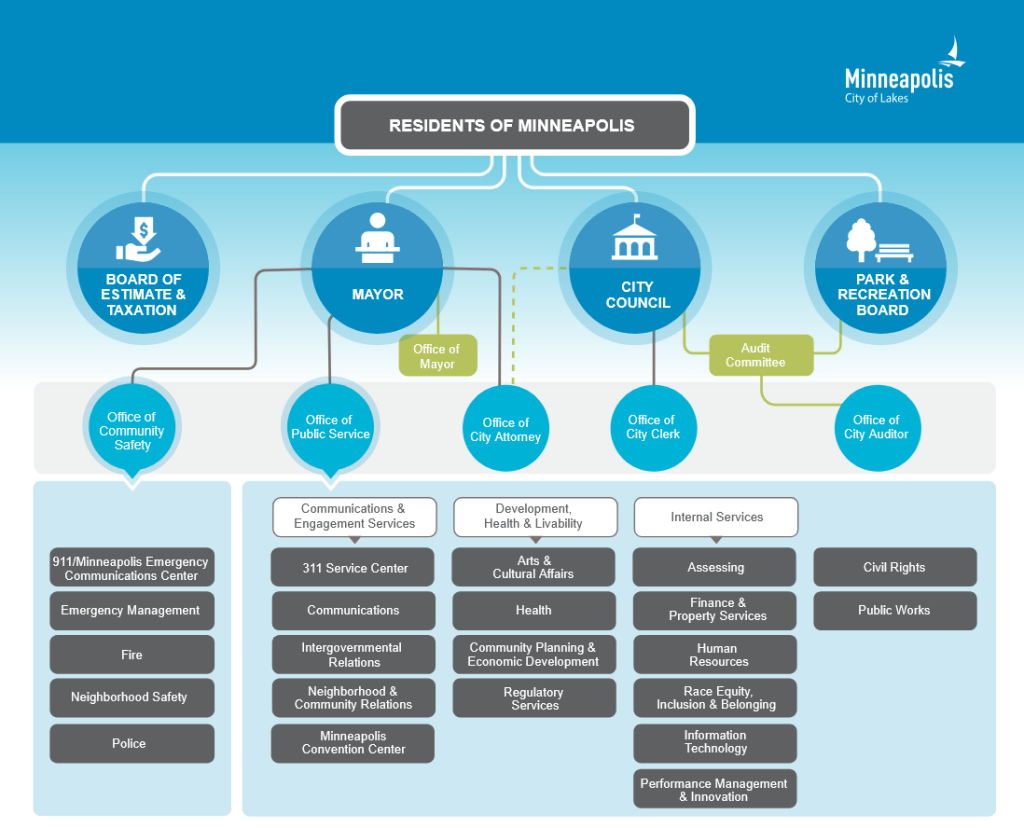
The design makes it a little hard to see, but if you follow the lines down from Mayor to Office of Community Safety and Office of Public Service, you’ll see little arrows that point down into the white and gray boxes, which are the various city departments. But, the city council no longer has any power over those departments. They do still have to confirm the appointment of a certain subset of department heads (similar to what the U.S. Senate does for Presidential cabinet nominees). But, they no longer have any say in who is fired, and have lost the ability to work directly with city staff without going through the mayor’s office first.
The City of Minneapolis has a genuinely useful webpage that lays out the roles of the mayor and city council in this structure. If you don’t want to read the full page, I summarized some of the most important roles and responsibilities in this chart.
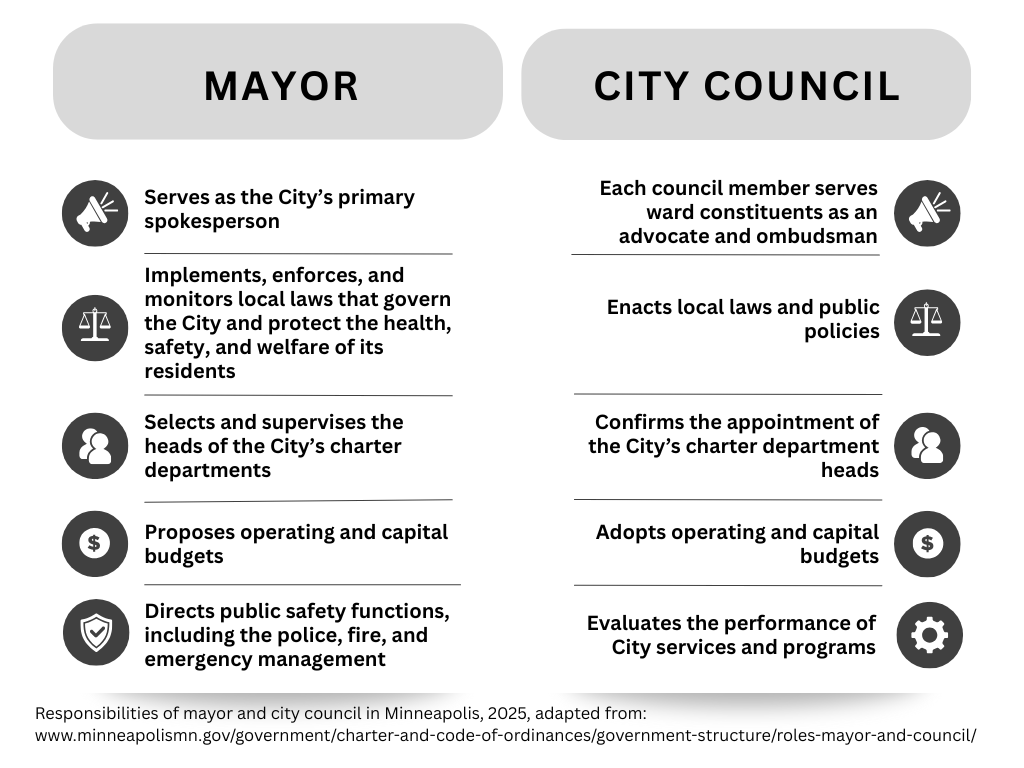
Unfortunately, the change to a system with clearer lines of accountability hasn’t stopped people from trying to blur those lines. In February, the Star Tribune published an opinion piece by columnist Andy Brehm with the following title and lede:
“Minneapolis continues to fail on public safety”
Violent crime is dropping in cities all over the country, but not in the City of Lakes. Minneapolis will continue its decline without new leadership on the City Council that’s serious about tackling it.
It includes this paragraph:
But too many members of the Minneapolis City Council remain unabashedly anti-police. Who wants to do an already dangerous job reporting to a governing body controlled by people opposed to your profession? MPD will never be able to maximize new hires with a council so hostile to its ranks. As Ward 3 Council Member Michael Rainville, a staunch supporter of men and women in blue and one of the finest public servants I know, told me: “They don’t say defund the police anymore. They just do it.”
Now that you have some background, the first inaccuracy you should notice in this excerpt is that the MPD does not “report” to the city council. Unless Brehm means that certain members of MPD leadership are sometimes asked to literally present reports to the city council? But, again, all those requests are filtered through the mayor’s office first. The city council has literally zero power to make demands of the MPD or change their policy. The only power of consequence that they do have related to the MPD is the responsibility to approve the city budget, which brings us to the second inaccuracy.
Despite what that quote from Council Member Rainville says, the Minneapolis City Council has never defunded the police. (Which, of course, he knows.)
Direct from the city’s public budget dashboard, here’s the MPD’s budget from the past 10 years.
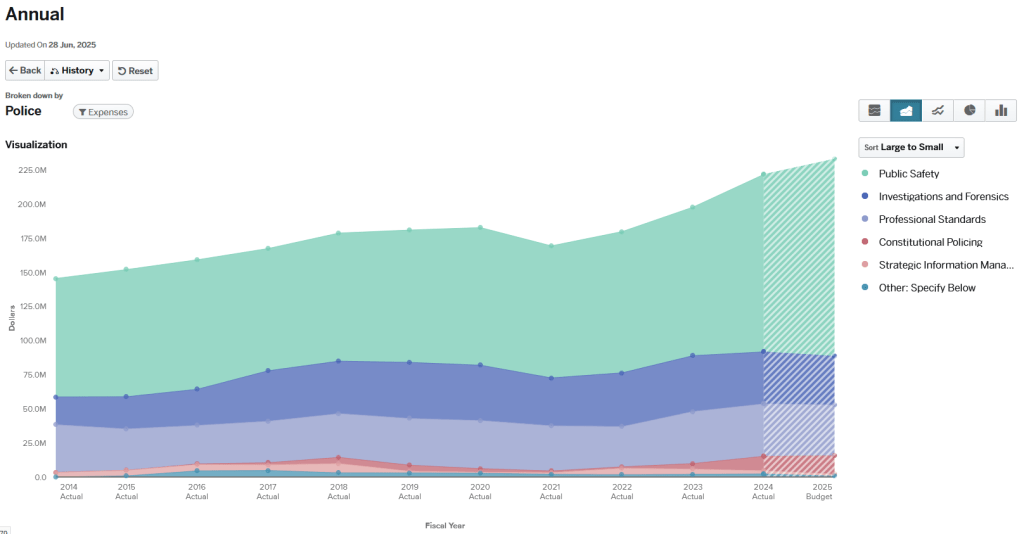
That one-year dip in 2021? That was the year after the pandemic, when Mayor Frey himself cut the whole city budget across the board, with good reason.
Elsewhere in the same piece, Brehm praises the decision of “the city” to give historic raises to MPD officers, and praises Mayor Frey for his leadership of the MPD, but does not mention that the City Council approved those historic raises. He also points to the very low staffing levels for officers (we currently have about 570 officers, compared to about 800 in 2020). However, he does not mention that, despite asks from community members to reduce spending on the police, the City Council has funded the Mayor and Chief’s requested number of officers every year since then.
There’s much more I could say about the nuances here and my feelings about they council’s decisions in this realm, but we’ll save it for another time. The bottom line is, the MPD (both as a department and individual officers) are getting more money now than ever before. And since, as we learned above, the city council approves every annual budget, Mayor Frey couldn’t have done that without the council’s approval.
But if you only read Brehm’s op-ed, you certainly wouldn’t know that.
Thankfully, the Star Tribune also published a counterpoint article by Jim Rowader, who was the Minneapolis City Attorney from 2020 through 2022, when the new government structure was being designed and implemented. Rowader writes:
What Brehm fails to share with readers is that, since 2021, Minneapolis has had a strong-mayor system of governance that shifted power away from the City Council. Failures to make necessary progress on public safety are, in fact, the responsibility of the city’s top executive: the mayor.
In a place with a truly healthy media ecosystem, and a political environment where candidates campaigned on facts, we wouldn’t need former city attorneys, or random bloggers like me, to frequently counter misinformation about the basic facts of how our city government works. Unfortunately, Minneapolis is not currently that place, and doesn’t show any signs of changing before November.
So, please, tell your friends and family what the Mayor of Minneapolis actually does, and make sure that whoever they plan to vote for, they’re basing that decision on reality.



 Mpls Musings
Leave a comment